A multi-cloud environment matches each workload to the provider that suits it best. It also splits protection across platforms that were never designed to work together. The gaps between their security models widen the attack surface an organization must defend. Multi-cloud security replaces provider-by-provider protection with one consistent set of policies and controls across every environment.
This article explains multi-cloud security challenges and risks, the core components of a security strategy, and the practices, tools, and mistakes to know.
What Is Multi-Cloud Security?
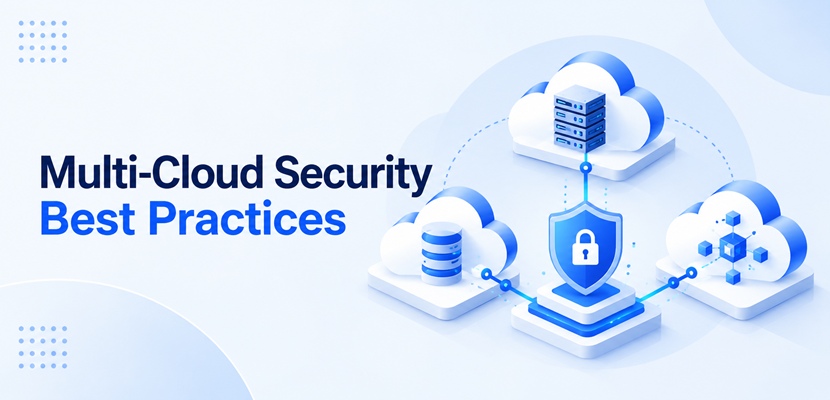
Multi-cloud security is the set of policies, controls, and tools that protect data, workloads, and identities across two or more cloud providers. It covers the same areas as single-provider cloud security:
- Access control.
- Data protection.
- Network security.
- Threat detection.
The difference is scope. Every control must cover several providers at once and work the same way on each, even though each provider uses different services and settings.
For example, a company runs its customer database on one provider, its analytics on a second, and its web front end on a third. All three environments need the same access rules, encryption standards, and monitoring coverage. Multi-cloud security ensures a user, workload, or dataset receives the same level of protection wherever it runs.
Security is also one part of a broader multi-cloud strategy, alongside governance, workload placement, and cost management.
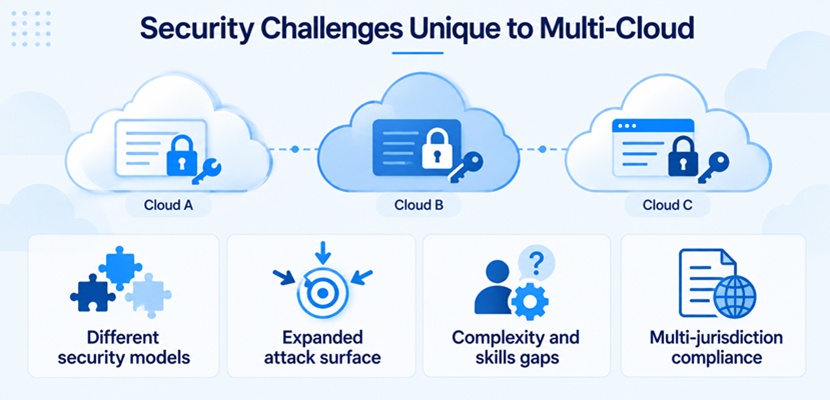
Security Challenges Unique to Multi-Cloud
Every cloud provider designs its security services around its own architecture, terminology, and default settings. In a multi-cloud environment, an organization’s security team must work with all of those security models at once. Each one comes with its own settings, alerts, and failure points. The challenges below come from that structure, not from a weakness in any single provider.
Different Security Models Across Providers
All major providers follow a shared responsibility model: the provider secures its infrastructure, and the customer secures what it deploys. How each provider implements its side of that model differs. A rule that grants narrow access on one platform sometimes grants broader access on another.
The main differences include:
- Permission models. Each platform attaches roles and policies to users, groups, and resources in different ways.
- Permission inheritance. Access rights pass down through account, folder, and project hierarchies according to each provider's own rules.
- Default policies. A new role, account, or resource starts with different access settings depending on the provider.
- Service defaults. Logging, encryption, and public access settings vary between providers and even between services on the same provider.
A secure configuration on one platform does not carry over to the next without deliberate work.
Expanded Attack Surface
Each provider added to a multi-cloud environment brings its own set of targets for attackers. The attack surface grows with every new platform, not just with every new workload, because each provider has its own access points and management layer.
New entry points for attackers include:
- User accounts and service identities. Each provider keeps a separate set, and each one is a target for stolen or guessed credentials.
- Cloud APIs. Management and service APIs accept authenticated requests from the internet by default, so a leaked key works from outside the organization.
- Management consoles. Every provider's web console is another login page that needs strong access controls.
- Network entry points. Public endpoints, load balancers, and open ports differ in setup and naming across providers.
- Cross-cloud connections. Interconnects, virtual private network (VPN) tunnels, and service integrations carry traffic and credentials between providers.
Unplanned growth makes the problem harder to control. Cloud sprawl leaves unused resources, forgotten test environments, and old credentials running in accounts that no one actively reviews.
Operational Complexity and Skills Gaps
Securing one cloud platform well requires detailed knowledge of its security services, alert formats, and identity model. A multi-cloud environment multiplies that requirement, and few teams have equal expertise across every provider they use.
The result is uneven protection. The provider a team knows best receives tighter controls, while the others run on defaults or partial configurations. Day-to-day multi-cloud management also slows down when every security change requires separate steps in each provider's console.
Compliance Across Multiple Jurisdictions
Data in a multi-cloud environment moves between providers and regions, and each location falls under different regulations. Privacy laws such as GDPR and CCPA set rules for how organizations collect, share, and protect personal data. GDPR also restricts transfers of personal data outside the European Union.
Provider certifications only cover the provider's own infrastructure. The organization must still prove that its own configurations meet each requirement in every environment, using evidence from platforms with different reporting formats. Healthcare data adds another complexity layer. HIPAA cloud storage requirements call for safeguards such as encryption and access controls, plus a business associate agreement with each provider.
Key Multi-Cloud Security Risks
The challenges of multi-cloud create specific weaknesses, such as mismatched settings, excess permissions, and blind spots between providers. Attackers look for these weaknesses because security teams working across several platforms tend to miss them.
Inconsistent Security Policies
Policy drift happens when the same rule gets implemented differently on each provider, or updated on one provider and not the others. A password policy, firewall rule, or data retention setting that starts out identical can drift apart after months of manual changes.
The weakest environment sets the actual security level for the whole organization. An attacker only needs one provider where a rule is looser to perform a data breach that exposes data the other providers protect correctly.
Misconfigurations
Misconfigurations are among the most common causes of cloud security incidents. Publicly readable storage, open management ports, disabled logging, and overly permissive network rules all come from settings that are easy to get wrong.
Multi-cloud raises the odds because each provider names, groups, and defaults these settings differently. Manual changes increase the risk further, especially on the providers a team works with less often.
Identity and Credential Compromise
Every provider maintains its own identities, including user accounts, service accounts, roles, and access keys. Non-human identities, such as the credentials that applications, pipelines, and automation scripts use, frequently outnumber human users and receive less oversight.
Long-lived access keys and over-permissioned roles create the biggest exposure. A stolen key from one provider gives an attacker a foothold, while credentials reused across shared pipelines or configuration files extend that access to other providers.
Limited Visibility and Monitoring Gaps
Each provider produces its own logs, alerts, and security findings, in its own format and console. Without a way to combine them, security teams review each environment separately and miss activity that spans more than one provider.
An attacker who gains access to one cloud and moves into another leaves a trail split across two unrelated log systems. Detection slows down, and some activity never gets reviewed at all, especially in accounts and regions outside the main monitoring setup.
Data In-Transit Vulnerabilities
Multi-cloud workloads exchange data through replication, API calls between services, and backups sent to a second provider. Every data transmission between providers crosses network paths the organization does not fully control, including the public internet in many setups.
Unencrypted or weakly encrypted traffic is open to interception through man-in-the-middle attacks and eavesdropping. Misconfigured interconnects and VPN tunnels create similar exposure by sending traffic that appears private over shared networks.
Core Components of a Multi-Cloud Security Strategy
A multi-cloud security strategy rests on a small set of components that apply to every provider in the environment. Each one works across providers instead of inside a single platform, which gives every cloud the same baseline of protection. Together, they close the risks described above.
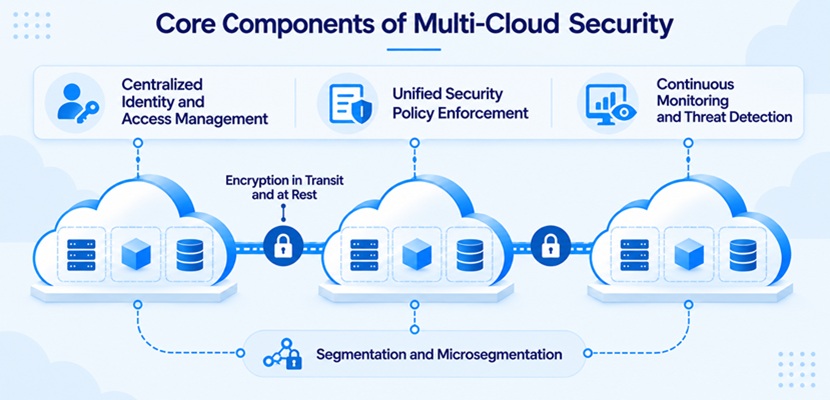
Centralized Identity and Access Management
Centralized identity and access management (IAM) connects every provider to one identity provider (IdP). Users authenticate once and receive access based on a single set of roles. Each cloud trusts the IdP through federation standards such as Security Assertion Markup Language (SAML) and OpenID Connect. Removing an account in one place revokes access everywhere.
Multi-factor authentication enforced at the IdP protects every provider at once. Applications and automated pipelines use the same approach, known as workload identity federation. Instead of storing permanent access keys, a workload receives a temporary token each time it connects to a provider. The token expires quickly, so no long-lived keys sit in code or configuration files.
Unified Security Policy Enforcement
Unified policy enforcement defines security rules once and applies them to every provider. Typical rules cover approved regions, required encryption, blocked public access, and mandatory resource tags. The rules live as version-controlled code, and each provider's native policy engine or a cross-cloud tool enforces them.
Enforcement works through two types of controls. Preventive controls block a noncompliant resource at creation, for example when infrastructure as code (IaC) templates request a public storage bucket. Detective controls compare running resources against the same rules and flag any that no longer match.
Data Encryption (In Transit and At Rest)
Encryption at rest protects databases, object storage, and backups on each provider. Encryption in transit protects data as it moves. It uses Transport Layer Security (TLS) between services and TLS or Internet Protocol Security (IPsec) on the links between clouds. Both apply the same standards regardless of which provider holds the data.
Key management determines who controls access to encrypted data. Each provider offers its own key management service. Some organizations keep keys in a central key manager or an external hardware security module (HSM) instead. This separation means no single provider holds both the data and the decryption key. For highly sensitive workloads, confidential computing extends protection to data in use by processing it inside hardware-isolated environments.
Continuous Monitoring and Threat Detection
Continuous monitoring applies cloud monitoring practices to security events. It collects logs, events, and security findings from every provider into one system and converts them to a common format. A security information and event management (SIEM) platform correlates the data across providers. A login on one cloud and a data transfer on another then appear as one sequence of events.
Detection covers both configuration state and runtime behavior, from a newly exposed port to unusual API activity. Alerts reach one team, often a Security Operations Center (SOC), with details on the provider, account, and resource involved. Audit logs from every provider stay available for the retention period compliance rules require.
Network Segmentation and Microsegmentation
Network segmentation divides each cloud environment into isolated zones, such as production, development, and sensitive data stores, with strict rules for traffic between them. Separate accounts or projects for each environment and application add a second boundary at the provider level.
Microsegmentation applies the same idea to individual workloads. Each workload communicates only with the specific services it needs, so an attacker who compromises one workload cannot move freely to the rest. Traffic between clouds passes through defined, encrypted gateways instead of open routes between provider networks.
Note: Some workloads need isolation beyond network rules. phoenixNAP's Bare Metal Cloud, a dedicated server platform with the flexibility of the cloud, runs them on single-tenant hardware that no other customer shares. API-driven provisioning and IaC integrations keep these servers under the same code-based policies as the rest of the multi-cloud environment.
Multi-Cloud Security Best Practices
Consistent day-to-day practice keeps the core components effective as the environment changes. Providers release new services and change defaults regularly, so security must be part of daily operations instead of a periodic cleanup.
The following practices apply to every provider:
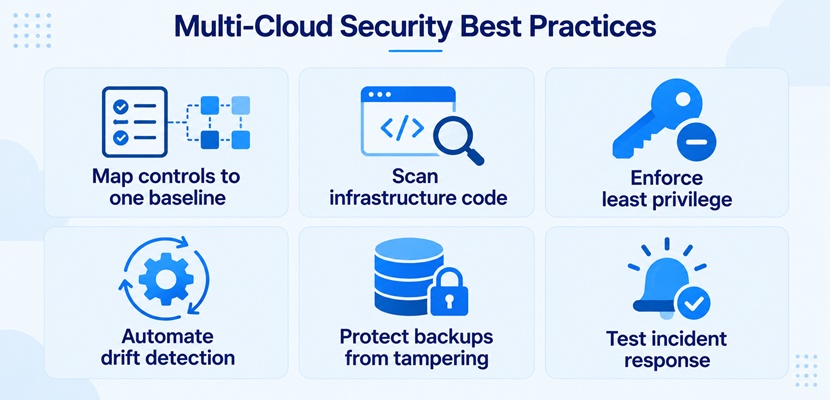
- Map controls to one baseline framework. Use common standards, such as CIS Benchmarks or the NIST Cybersecurity Framework, and map each provider's native controls to them.
- Scan infrastructure code before deployment. Check templates against security policies in the CI/CD pipeline. This DevSecOps habit stops misconfigurations before they reach any provider.
- Enforce least privilege. Apply the principle of least privilege to every role, replace standing privileged access with time-limited access, and review permissions across providers on a set schedule.
- Automate drift detection and remediation. Automating configuration checks catches changes from the approved baseline as they happen and fixes known issues without manual review.
- Protect backups from tampering. Store immutable backups in a separate account or provider so they stay recoverable even if an attacker gains administrative access.
- Test incident response across providers. Run exercises that follow an attack from one cloud into another. Confirm the incident response plan gives the team the access and logs it needs in every environment.
Regular vulnerability assessments keep these practices current as environments change, while a documented cloud security strategy ties them to the organization's wider security goals.
Multi-Cloud Security Tools
Most organizations combine several categories of security tools, since no single product covers every part of multi-cloud security. Many vendors now bundle these categories into one platform, which reduces the number of consoles a security team has to watch.
The main tool categories are:
| Tool Category | What It Covers | Supports |
|---|---|---|
| Cloud-Native Application Protection Platform (CNAPP) | Combines posture management, workload protection, and permission analysis across providers in one platform. | Multiple Components. |
| Cloud Security Posture Management (CSPM) | Checks configurations against security policies and compliance frameworks continuously. | Policy Enforcement. |
| Cloud Infrastructure Entitlement Management (CIEM) | Analyzes permissions across providers and flags excessive or unused access. | Identity and Access. |
| Security Information and Event Management (SIEM) | Collects and correlates logs and alerts from every provider. | Monitoring. |
| Identity Provider (IdP) | Handles single sign-on and federation for users and workloads. | Identity and Access. |
| Secrets and Key Management | Stores credentials and encryption keys outside application code. | Encryption. |
| Policy as Code | Defines and enforces security rules as version-controlled code. | Policy Enforcement. |
A CNAPP or CSPM tool combined with a central SIEM covers the largest share of multi-cloud security needs, with specialized tools added where gaps remain. Provisioning and cost control fall outside this stack and belong to multi-cloud management tools.
Common Multi-Cloud Security Mistakes to Avoid
Organizations with solid tools and components still leave gaps through assumptions about scope, ownership, and trust. The following mistakes often go unnoticed until attackers exploit them through common cyberattacks.
The most common mistakes include:
- Adding a new tool for every gap. Each tool brings its own console and alert format, which recreates the visibility problem it was meant to solve.
- Excluding non-production environments. Development and test accounts often hold copies of real data and credentials with access to production systems.
- Leaving security ownership undefined. When no one owns security for a given account, alerts go unanswered and risky settings stay in place.
- Letting temporary exceptions become permanent. Open firewall rules or elevated permissions added during an incident or migration stay active long after the need has passed.
- Overlooking SaaS applications. Programs focused on infrastructure providers miss software as a service (SaaS) applications that store the same sensitive data, which weakens data loss prevention efforts.
- Trusting internal network traffic by default. Internal networks span several providers, so implicit trust lets an attacker move from one environment to the next. Zero trust network access (ZTNA) verifies every request instead.
Most of these mistakes stem from security decisions that go unreviewed as the environment grows. Scheduled reviews of tool coverage, account ownership, and open exceptions keep them from turning into entry points for attackers.
Keep Multi-Cloud Security Consistent Across Every Provider
Multi-cloud security works when every provider follows the same rules for identity, data, and monitoring, however differently each platform implements them. That consistency keeps the weakest environment from setting the security level for the whole organization. Start by auditing where your providers' controls differ and bring the most exposed environment up to your baseline before adding another provider.